Grafton Close · Richmond upon Thames · Institutional accountability

When survivors seek answers, who answers for Richmond?

By Keith Hinchliffe · Grafton Close survivor and independent researcher

The council acknowledges unacceptable historical leadership at Grafton Close. I lived at Grafton Close in 1984. When I sought records, recognition and support, I found myself dealing with solicitors acting for Richmond and its insurers in my negligence claim. The documentary record raises questions not only about the abuse of children, but about how survivors are treated decades later.

My experience · In my own words

I wanted acknowledgement and my records—not a fight with an insurer.

In my published interview of 8 April 2026, I explained that when I first approached Richmond and its children’s-services arrangements, I wanted my childhood records, an explanation of what had happened at Grafton Close and recognition and assistance for survivors. The subsequent involvement of solicitors acting for the council and its insurers made me feel that my requests for answers were being treated principally as a liability dispute.

That is my firsthand account of the process. I believe its effect was to wear me down, but a deliberate strategy to discourage me is not established as the council’s admitted motive. The question the documented correspondence permits us to ask is whether an effective and compassionate survivor-response process operated independently of its insurers’ legal defence.

Sources: 8 April 2026 survivor interview · 21 February 2024 published investigation.

Recognition

Did every survivor who came forward receive a personal response to their own account, not just a general public statement?

Records

What searches were undertaken, which repositories were contacted, and where are the original destruction or transfer records?

Redress

Was support or an independent restorative response offered separately from the disputed question of civil liability?

Checked against surviving original letters

The insurers’ legal response is documented.

I have checked the following passages against my preserved Browne Jacobson correspondence. Limited excerpts are reproduced for public scrutiny; the full private case file, contact details and sensitive personal records have not been uploaded here. A solicitor may legitimately contest liability, but the documents also show the response I received.

17 February 2021 · Liability response

The council and its insurers

“instructed to act on behalf of the Council and its insurers”

In its original written response, Browne Jacobson explicitly identified its instruction as acting for the council and its insurers. The letter also relied on historical records-retention information to explain why my original care records were thought to have been destroyed. A retention assumption is not a disposal certificate.

Source: original 17 February 2021 letter, privately held and reviewed against the source-extracted text; related public reporting: Hencke’s investigation.

23 September 2024 · Further correspondence

Duty of care acknowledged; negligence disputed

The solicitors accepted that Richmond owed me a duty of care during my Grafton Close placement. They continued to dispute whether breach and causation could be established and referred to missing historical records and the passage of time.

“we do not respond to each individual e-mail we receive from you”

That was the firm’s stated limit on ongoing correspondence. It does not prove an intention to exhaust a survivor, but is relevant when assessing how accessible the council’s process was to someone pursuing historical recognition and answers.

Source: preserved 23 September 2024 Browne Jacobson letter. Its civil-defence position is not automatically the position of every department or service within Richmond.

18 October 2024 · Further correspondence, reassessed 22 October 2026

Why the earlier Stingemore case and McSweeney conviction matter to third-party safeguards

In the preserved correspondence of 18 October 2024, the solicitors dismissed the relevance of safeguards following the earlier Stingemore offending because Philip Saunders was a third party, not a Richmond employee. That is a contested defence position. The safeguarding question is not confined to whether Richmond employed Saunders: it also concerns what the council knew, what risks to children in its care were reasonably foreseeable, and whether its own arrangements for adult access, visits and taking children away were adequate and followed in 1984.

Earlier criminal proceedings: a retained criminal-record extract records a guilty plea by former Grafton Close manager John Stingemore to indecent assault of a 14-year-old child, concerning an offence on or before 31 July 1981. The record is provisionally catalogued as circa 1983, but the precise prosecution and disposal dates require confirmation from the full court record. Former social-services director Louis Minster separately described having been told about police enquiries in 1982. Those distinct sources raise a specific question: what review of the home’s safeguarding arrangements took place after that warning and earlier case?

McSweeney was not the home manager. Anthony McSweeney, a priest associated with Stingemore, was described in 2015 trial reporting as a regular visitor and ad hoc helper at Grafton Close; his precise employment or payment status should be established from records rather than assumed. On 27 February 2015 he was convicted in relation to the indecent assault of a boy at the home between 1979 and 1981, and on 27 March 2015 he was sentenced to three years’ imprisonment. He was acquitted of other charges involving two boys. The conviction is evidence of abuse associated with an adult outside the home’s management; it does not establish that the earlier Stingemore plea involved the identical incident, or that Richmond or police necessarily knew of McSweeney’s offences when the earlier case was dealt with.

Why was McSweeney not prosecuted in the earlier period? That is a legitimate question for the police and the surviving prosecution files, not proof in itself of deliberate inaction. For Richmond, the parallel question is why the earlier offending and police enquiries did or did not trigger effective restrictions or supervision of outside adults. If the answer is that no meaningful assessment was undertaken, that would be relevant to the alleged breach; if an assessment was undertaken, its documents and implementation should be produced.

My subsequent case: Philip Saunders was convicted at Reading Crown Court in October 2023 and sentenced to six years in December 2023, after I gave evidence under oath and faced cross-examination. The judge’s sentencing remarks expressly recognised the harm caused. The conviction and testimony are substantial evidence concerning Saunders’s abuse. My separate account is that Saunders attended Grafton Close and was able to remove me while Richmond was responsible for my care. The criminal verdict did not determine whether Richmond itself breached a civil duty, but nor should a serious safeguarding enquiry dismiss the 1984 removal circumstances simply because Saunders was not a council employee.

What the solicitor’s evidential objection does not answer: I gave sworn evidence, was cross-examined and secured a Crown Court conviction against Saunders. It is legitimate to require separate evidence that Richmond breached its own duty in 1984, but treating the lack of an already assembled civil-trial case as a reason not to address the safeguarding questions would conflate two different stages. A reasoned response should acknowledge what the criminal proceedings established, identify the particular elements of negligence still disputed, and explain what council-held records have been examined or preserved.

What Richmond should answer: who knew about the earlier Stingemore offending and 1982 police enquiries, and when; whether adult visitors and helpers such as McSweeney were recorded, vetted, escorted or supervised; what visitor, collection, leave and return procedures were revised or enforced afterwards; and who authorised or recorded Saunders taking a child from the home in 1984. These are questions about Richmond’s own systems and decisions, not an attempt to impose automatic vicarious liability for Saunders.

Evidential position: the earlier guilty plea, McSweeney’s later conviction and the Saunders conviction do not alone prove Richmond’s direct negligence or causation. They do, however, justify testing foreseeability, the standard applicable in 1984, the safeguards actually operating, any breach and the additional harm said to have resulted. Criminal conviction requires proof beyond reasonable doubt; civil negligence is generally decided on the balance of probabilities. The council and its representatives are entitled to dispute a civil claim, but that does not turn these court outcomes into mere unsupported allegations.

Sources: preserved Browne Jacobson correspondence dated 18 October 2024; Stingemore earlier guilty-plea extract (approximate date); 1982 management-awareness evidence; ITV trial report, 27 February 2015; ITV sentencing report, 27 March 2015; published account of Saunders’s conviction and Richmond dispute; Thames Valley Police and Saunders case; Richmond direct safeguarding case. Court records and dated council disclosures should be preferred where available.

What this evidence establishes: the council and insurers engaged solicitors; the solicitors’ correspondence contested particular civil-liability elements, limited responses and took a stated position on previous safeguards. What it does not establish on its own: a covert policy of wearing down survivors, identical treatment of every complainant, or the absence of all possible support services.

Historical institutional knowledge

Safeguarding concerns did not begin in 1984.

The historical picture was not limited to the later conviction of John Stingemore’s visitor and friend Anthony McSweeney. A separate criminal-record extract records an earlier guilty plea by Stingemore for indecent assault at Grafton Close, concerning an offence on or before 31 July 1981. The exact court disposal date for that earlier record still needs to be authenticated, and should not be silently labelled a proven 1983 conviction.

In an October 2014 interview, Louis Minster, Richmond’s former Director of Social Services, said that Terry Earland had informed him in 1982 of police enquiries. Minster said he had instructed cooperation with police but had not commissioned his own internal investigation. Separately, Earland described briefing political leadership about abuse-related concerns. These are attributable accounts from former senior officials, not proof that every individual knew every allegation.

In February 2015, after McSweeney’s conviction, council chief executive Gillian Norton expressly acknowledged that the service leadership and management shown in court were unacceptable. A 2022 council statement reaffirmed that position regarding the earlier crimes.

Sources: Stingemore primary-record image · Minster interview, 2014 · Earland reporting, 2013 · Richmond statement, 2015 · Richmond statement, 2022.

What happened between those warnings and later placements?

The relevant questions are what risk information reached management, what was recorded, whether policies for adult visitors and off-site departures changed, how compliance was supervised, and whether protections actually operated when other children entered the home. It is a safeguarding question about the system, not simply whether the council had advance knowledge of the identity of each future abuser.

A 19 July 1982 ministerial explanation of the Community Homes Regulations 1972 also points to monthly visiting and written oversight reports for relevant categories of community home. Whether and precisely how those provisions applied to Grafton Close in 1984 must be independently established before claiming such reports were legally required for this particular home.

Original official source: Hansard, 19 July 1982.

The outside-adult safeguarding question

McSweeney was also an outside adult. Why is that distinction decisive for Saunders?

Anthony McSweeney was a Catholic priest who visited and assisted at Grafton Close. Reporting of the 2015 sentencing says police regarded him as a temporary helper and that Richmond had not formally employed him. Contemporary trial reporting also mentioned the possibility he had been on the payroll for a time. The exact terms of any arrangement require primary employment records, but his established role illustrates the danger that can arise from access by someone outside the council’s ordinary staff.

McSweeney’s 2015 conviction concerned sexual abuse at Grafton Close between 1979 and 1981, involving the home’s then manager John Stingemore. Saunders’ conviction arose from the separate survivor’s abuse and the subsequent claim that Richmond failed to prevent access and removal from care in 1984. The cases are not legally identical, and an employee’s direct involvement in the earlier case is an important difference. Nevertheless, they raise a shared operational question: what system should Richmond have maintained to control the access of visiting adults to vulnerable children?

Two prosecution timelines, not one

Stingemore: Earlier court extract records a guilty plea for an offence on or before 31 July 1981; the associated disposal date is not yet verified. He was also due to face the later case jointly with McSweeney but died before trial.

McSweeney: Arrested February 2013, trial began 16 February 2015, convicted 27 February 2015 and sentenced 27 March 2015. His earlier arrest, charging history, policing of contemporaneous reports and timing of renewed investigation require careful historical reconstruction.

Saunders: Convicted of seven offences in October 2023 and sentenced to six years’ imprisonment on 1 December 2023. The distinct 1984 issue is Richmond’s safeguarding of the child during placement, regardless of Saunders’ lack of employment by the council.

This is also an important police-accountability question: what evidence was available about McSweeney before 2013, who held it, and why did the criminal investigation only result in his prosecution decades after the offending? A long interval is a reason to examine original police records—not, without those records, proof of a deliberately stalled prosecution.

Sources: 2013 arrest and 2015 sentence · 16 February 2015 trial reporting · Ad hoc helper and employment-status reporting · Separate Saunders investigation chronology.

Public apology and present-day practice

Richmond apologised for past abuse. Is every survivor’s experience recognised?

Richmond has issued public statements of regret. That matters and must not be denied. But there is a difference between a general apology following one prosecution and a full response to each survivor’s account, access to their care records, transparent examination of institutional failures, consideration of support and an appropriate redress process.

I believe my correspondence and published interview raise legitimate questions about whether those responsibilities were met in my case. They do not establish that Richmond denied every survivor an apology or that every historical allegation has been determined by a court.

In a parliamentary answer on 2 June 2026, the Department for Education said it was not considering a separate Grafton Close inquiry. It placed assessment of Richmond’s historic handling of safeguarding concerns with the council locally. That creates a clear public-interest question about the independence and adequacy of institutional scrutiny.

Official response: Department for Education answer, 2 June 2026.

An evidence-led request for accountability

Questions Richmond and the relevant police forces should be able to answer

  1. Who received and evaluated abuse warnings in the early 1980s, including reports from staff, children and police?
  2. Why was Stingemore removed from his position, and what action was recorded concerning the outside adults who had access to children?
  3. What changed after 1981: visitor controls, authorised departures, supervision, escalation of concerns and independent inspection?
  4. How did those arrangements apply to my 1984 placement and to children at other council homes, if common policies applied?
  5. How were surviving Grafton Close files searched, transferred, retained or disposed of, and where are the original custody and disposal records?
  6. What non-litigation pathway existed for a survivor seeking records, recognition, counselling, a personal apology or restorative redress?
  7. What records explain the early handling of allegations concerning McSweeney and the later initiation of the prosecution that culminated in 2015?
  8. What independent scrutiny will now consider Grafton Close across its full operating history, including children whose accounts were never part of Fernbridge?

The distinction is deliberate: documented failures, published institutional acknowledgements, source-backed survivor experiences and unresolved allegations have different evidential statuses. I am seeking answers that original documents can support, rather than declaring motives or misconduct beyond the available record.

View the original source archive How evidence is assessedThe unanswered Fernbridge investigation

Provenance · primary and public sources

Check the sources

Survivors’ identities, allegations not tested by a court, and personal records of third parties are not disclosed through this page. Public factual corrections can be requested through the website contact page.

Original correspondence · Council and Parliament

When I sought public accountability: two original replies.

I publish the following document images as evidence of what the elected representatives told me, not as proof that all my allegations were accepted or investigated to completion.

Munira Wilson MP — 29 September 2020

MP correspondence dated 29 September 2020 concerning Grafton Close, with private footer omitted

Munira Wilson wrote that she had contacted Richmond Council’s chief executive to seek assurances that my concerns were properly investigated. This records the assurance she was seeking, not the Council’s subsequent actions or the outcome of an investigation.

Read original correspondence ↗

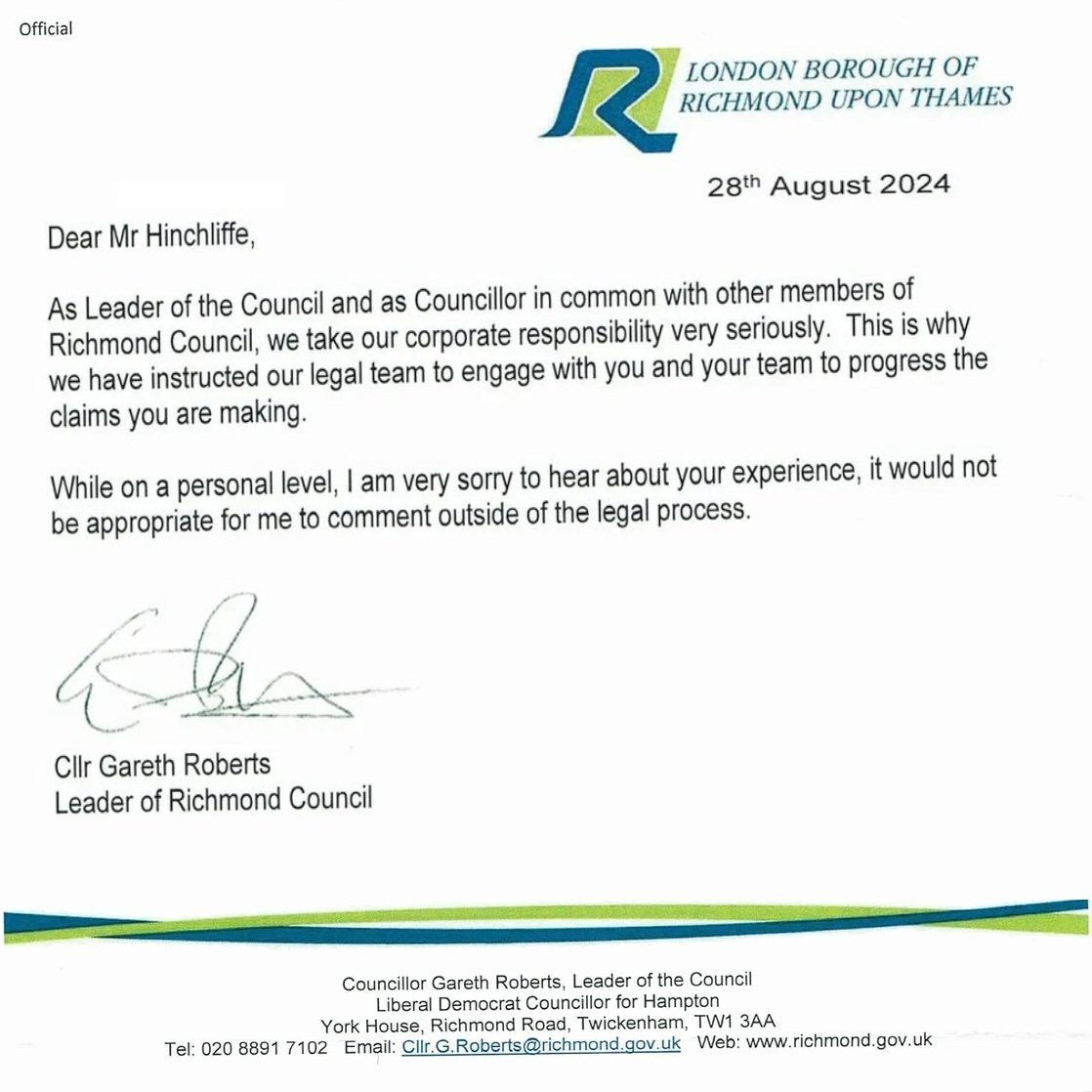
Council Leader Gareth Roberts — 28 August 2024

Letter dated 28 August 2024 signed by Richmond Council leader Gareth Roberts

Councillor Roberts expressed personal sympathy, said the Council took corporate responsibility seriously and referred my claims to the Council’s legal representatives. The letter does not admit breach of duty, establish the merits of an individual claim or identify a safeguarding decision in 1984.

Read Council leader’s letter ↗

Source rule: these are the actual correspondence images. What the letters say is distinguished from what any police or Council investigation later established.

An independent survivor-led investigation, not an official court finding. Testimony, corporate statements and unverified leads remain distinguished. Editorial standards.